

If you want to study faster, you have to stop relying on passive habits like rereading your notes over and over. The real secret isn't about finding more hours in the day; it's about building a smarter system for learning—one built on active recall and strategic organization.
Why Traditional Study Habits No Longer Work
Let's be honest: the old advice to just "study more" is completely broken. We're all drowning in information, so the real challenge isn’t finding more time but learning more effectively in the time you actually have. So many students feel this pressure.
I certainly did. During my second year of engineering school, I was juggling a heavy course load and a part-time job, and I felt like I was constantly falling behind. The volume of material for thermodynamics and circuit analysis was staggering. My go-to methods—highlighting nearly every sentence and rereading my chaotic notes—weren't cutting it. I'd spend hours "studying" only to blank on a quiz. That pressure is what ultimately forced me to find better, faster ways to learn.
The Modern Student's Reality
Today's academic world is more demanding than ever. Students are constantly balancing classes with jobs, internships, and personal lives, which makes those long, uninterrupted study sessions feel like a distant dream. The hard truth is that most students are working with very limited time.
A 2022 survey of over 1,000 students revealed that 50.5% spend less than two hours a day studying. Even in tough fields, many students in Engineering (25.42%) and Business (28.2%) only manage between six to 10 hours of studying per week. This data makes one thing crystal clear: your success depends entirely on making those few hours count. You can dig deeper into these trends in the full student habits report.
Learning how to study faster isn’t about being lazy—it’s about survival. It's about truly mastering material in the limited time we have, so we can succeed without sacrificing our well-being.
The Problem with Passive Learning
The biggest issue with traditional study habits is that they are fundamentally passive. Things like rereading, highlighting, and summarizing might create a comforting illusion of familiarity, but they do very little to build genuine understanding or long-term recall.
Here’s a practical look at why these common methods often fall short:
- Rereading: This is probably one of the least effective study techniques. Your brain recognizes the text, which makes you feel like you know it, but this is a trap called the "fluency illusion." For example, reading a chapter on photosynthesis five times might make the words familiar, but it doesn't mean you can explain the Calvin cycle from memory.
- Highlighting: It feels productive, but highlighting too much is counterproductive. If your page ends up looking like a rainbow, you haven't actually pinpointed the key ideas. You aren't forced to process the information, just identify it.
- Massed Practice (Cramming): Pulling an all-nighter might get you through tomorrow's exam. But all that information is shoved into short-term memory and vanishes almost as quickly as it went in. I once crammed for a history final and passed, but a week later, I couldn't tell you a single cause of the event. It’s a recipe for burnout and zero long-term retention.
At the end of the day, these outdated strategies waste your precious time without producing lasting results. The real solution is to shift from passive exposure to active engagement with your study material. It's time to build a smarter system for learning, which is exactly what we'll dive into next.
Getting Your Head in the Game: Setting the Stage for Learning
Before you even think about cracking open a textbook, let's talk about what's happening around you. Your study space and your mental state are the foundation of any successful learning session. If your desk is a mess and your phone is constantly buzzing, you're fighting an uphill battle from the start.
The idea here is to build a system that tells your brain, "Okay, it's time to focus." Think of it like a pilot's pre-flight checklist. They don't just wing it; they go through a specific, intentional routine to ensure a smooth flight. Your study time deserves that same level of preparation.
I learned this the hard way. My dorm room was a disaster zone for concentration. My phone buzzed with group chat notifications, my laptop had 20 unrelated browser tabs open, and my notes were in a chaotic pile. The first, most crucial step to studying faster wasn't a new technique—it was taming my environment.
Building Your Focus Zone
Your brain is incredibly good at making connections. When the place you study is also where you binge-watch shows and scroll through social media, your brain gets confused. The secret is to designate a space that is used only for focused work. I developed a simple pre-study ritual that acted as a trigger for my brain to switch into gear.
Here’s my actionable five-minute ritual:
- Desk Reset: I'd clear everything off my desk except the absolute essentials: my laptop, the relevant textbook, and a notepad. Everything else—phone, snacks, other books—got moved out of sight. Out of sight, out of mind.
- Define the Mission: I stopped using vague goals like "study biology." Instead, I'd get specific: "Complete Chapter 5 practice questions and create 15 flashcards on the Krebs cycle." This clarity makes the task feel manageable and gives you a concrete finish line.
- Digital Lockdown: I used a free browser extension to block distracting websites (Reddit, YouTube, news sites) for a 50-minute block. This is non-negotiable. Creating this digital quiet zone is one of the biggest boosts to focus you can give yourself.
This whole process took less than five minutes, but it completely transformed the effectiveness of my study sessions. It was a clear signal to my brain that it was time to get serious, removing the mental drag that so often comes with starting a new task.
The best study environment is one where focusing is the easiest option. When you proactively remove distractions and set clear goals, you pave the way for deep work.
Getting this right is fundamental. You're not just tidying up; you're engineering an environment for accelerated learning. Once your stage is set, you'll find that powerful techniques like active recall—which we're about to get into—become dramatically more effective.
Make Your Brain Work for You with Active Recall and Spaced Repetition

If you genuinely want to study faster, you have to stop just looking at your materials. The real secret lies in two powerhouse techniques backed by solid science: Active Recall and Spaced Repetition. This isn't about grinding harder; it's about making your brain do the heavy lifting in a way that actually works.
Forget rereading chapters until your eyes glaze over. That’s passive, and it’s a waste of time. Active recall is all about pulling information out of your memory, not just pushing it in. Think of it like a mental workout. For example, instead of rereading a definition, close the book and try to write it out in your own words. That struggle is what builds strong neural pathways.
Go Beyond Basic Flashcards with Active Recall
Flashcards are the classic tool for active recall, but the principle is much bigger than that. The core idea is to create situations where you have to produce the answer from scratch, not just recognize it on the page. I still remember trying to learn anatomy by staring at textbook diagrams—all the names of bones and muscles just became a blur.
Everything changed when I started quizzing myself. I’d cover the labels on a diagram and try to redraw it from memory. Or, after a lecture on a historical event, I'd grab a blank sheet of paper and write down a timeline of what happened and why, without looking at my notes. It was tough, but that struggle is exactly what makes the information permanent.
A fantastic way to put this into practice is the Feynman Technique:
- Grab a concept you're trying to learn (e.g., "supply and demand").
- Explain it out loud like you’re talking to a 10-year-old. Use simple words and analogies. "Imagine you're selling lemonade. If it's a hot day, lots of people want it (high demand), so you can charge more..."
- Find your weak spots. The moment you get stuck or have to use jargon ("elasticity," "equilibrium price"), you’ve found a gap in your knowledge. Go back to your notes to fill it in.
- Simplify again. Rework your explanation until it's crystal clear and concise.
This process forces you to truly understand a topic, not just memorize a definition.
Lock in Knowledge with Spaced Repetition
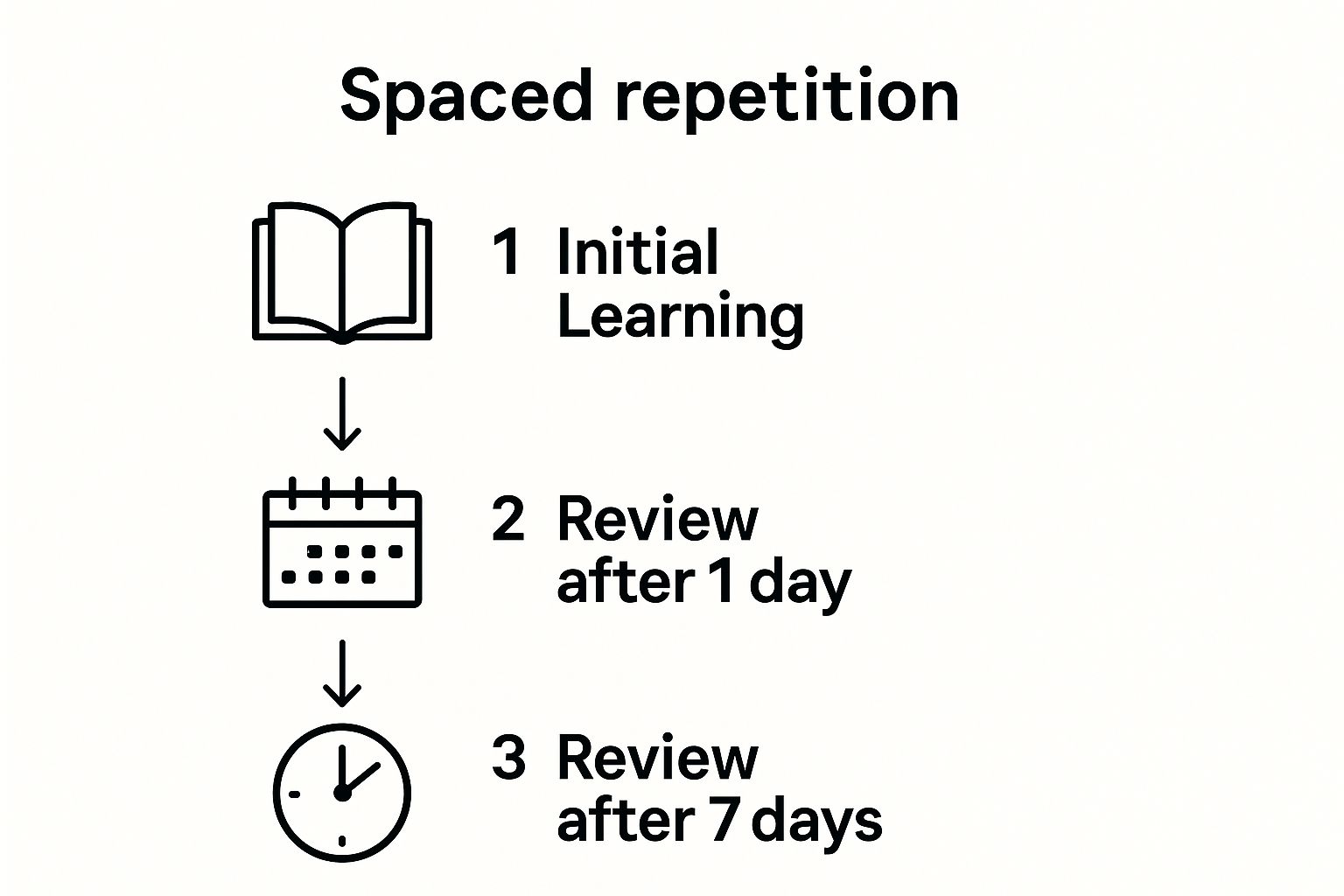
Active recall is potent, but pairing it with spaced repetition is where the magic really happens. This technique interrupts the brain's natural forgetting curve by having you review information at increasing intervals. It’s how you move knowledge from your fragile short-term memory to your long-term vault.
Instead of a panicked, all-night cram session, you review material strategically over time. Here’s a practical schedule you could follow for a new topic:
- Review 1: Within 24 hours of first learning it.
- Review 2: 3 days later.
- Review 3: A week later.
- Review 4: Two weeks after that.
The exact schedule isn't as important as the expanding intervals. It feels way less intense than cramming, but it’s infinitely more effective for building knowledge that lasts. For a deeper dive into this, our guide on how to study effectively for exams can be a huge help.
By testing yourself right at the moment you’re about to forget something, you send a powerful signal to your brain: "Hey, this is important. Don't delete it."
This push for smarter learning isn't just a personal quest; it's a global phenomenon. The worldwide education market is projected to skyrocket to nearly $10 trillion by 2030, largely because of a massive demand for more effective learning methods. This trend shows a collective effort to improve how we learn, making faster, smarter studying a critical skill. You can learn more about these global education trends and the future of learning.
Building Your Digital Study Workflow
Knowing about powerful learning theories is one thing. Actually using them consistently is another. The secret is building a smart system that does the heavy lifting for you. A solid digital workflow removes friction, automating the tedious bits so you can focus on what really matters—learning. This isn't about collecting apps; it's about creating a seamless process that turns your study materials into an organized, searchable knowledge base.
I've been there. I spent years of my academic career hunched over textbooks, painstakingly handwriting flashcards from dense chapters. The process was so draining that I often felt behind before I even started the real work of studying. That frustration is what pushed me to build a digital system that could handle the grunt work, saving me countless hours.
Let PDFFlashcards Handle the Repetitive Work
The first move in an effective digital workflow is to automate the most mind-numbing tasks. Manually creating flashcards from a 100-page PDF? That's a perfect example of a low-value, high-effort activity a machine can do better and faster. This is where a tool like PDFFlashcards completely changes the game.
Instead of dedicating hours to typing out questions, you can instantly generate active recall material from any PDF—lecture slides, textbook chapters, or dense research papers. This automation frees up your time and mental energy to focus on actually understanding the concepts.
Here’s a practical example: last semester, I had a 70-page PDF on neuropsychology. Instead of spending a weekend creating flashcards, I uploaded it to PDFFlashcards. Within five minutes, I had a comprehensive deck of questions and answers, ready for study.
Suddenly, studying goes from being a chore to a targeted, efficient activity. By completely cutting out the manual creation step, you're far more likely to stick with active recall, which is the entire foundation for studying faster.
Create Your Second Brain in Notion
Once you have your flashcards, you need a place for them to live. That’s where Notion comes in, acting as your "Second Brain"—a central hub for every subject, note, and resource. By embedding your decks from PDFFlashcards directly into your Notion pages, you create a powerful, all-in-one study environment.
Here’s a simple, actionable way to set it up:
- Make a Master Page for Each Subject: Create a page in Notion for "Biology 101" or "History of Ancient Rome." This is your command center.
- Embed Your Flashcard Decks: Inside that page, make sections for each topic (e.g., "Week 3: Cellular Respiration"). Then, embed the corresponding flashcard deck from PDFFlashcards right there.
- Link Your Notes and Readings: Right below the flashcards, add your lecture notes, summaries, and links to relevant articles or videos. Everything you need is now in one spot.
- Track Your Progress: Add a simple checklist or a small table to track your review sessions for each deck. Ticking a box after a review session is surprisingly motivating and makes spaced repetition almost effortless.
This digital workflow isn't just about storage; it's about connection. When your flashcards live right next to your notes, you can effortlessly jump between drilling specific facts and reviewing the big-picture concepts. This builds a much deeper, more integrated understanding of the material.
The shift toward digital learning tools isn't just a small trend; it's a massive wave. The online learning industry is projected to hit a staggering $686.9 billion by 2030. This boom is driven by a global demand for more flexible and efficient ways to learn. It allows students to adopt tools that help them absorb information faster, which directly answers the question of how to study more effectively. You can find more eye-opening online learning statistics to see just how much these trends are reshaping education.
This isn't just about convenience. It’s about building a fundamentally better process for learning. Take a look at the table below, which compares the old way of doing things with this more active, digital approach.
Study Method Comparison: Passive vs. Active Digital Workflow
| Metric | Traditional Passive Studying | Active Digital Workflow (PDFFlashcards + Notion) |
|---|---|---|
| Speed | Slow, manual, and time-consuming. | Fast. Flashcard creation is automated in minutes. |
| Effort | High effort on low-value tasks (e.g., re-writing). | Low effort on administrative tasks; high focus on learning. |
| Organization | Disorganized. Notes, books, and flashcards are separate. | Centralized. All materials are linked in one place (Notion). |
| Retention | Poor. Passive reading leads to quick forgetting. | Excellent. Built around active recall and spaced repetition. |
As you can see, the digital workflow isn't just a minor improvement—it’s a complete overhaul of the study process, designed for efficiency and long-term retention from the ground up. You're no longer just cramming; you are engineering a reliable system for learning.
Making Your New Study System Stick

Knowing all the best study techniques is one thing, but actually building a habit you can stick with? That's a completely different ballgame. The initial rush of setting up a slick new workflow with PDFFlashcards and Notion is great, but that excitement can wear off, leaving you tempted to fall back into old, ineffective habits like all-night cramming.
The real key to making this system work long-term isn't about intensity; it's all about consistency. Your goal is to create a routine with so little friction that effective studying becomes the easiest choice you can make. This means weaving your new digital tools into a practical weekly schedule that favors short, frequent reviews over draining marathon sessions.
Plan Your Reviews Before You Need Them
This is probably the biggest mistake students make. They wait until they feel the pressure to review, but by then, they're already playing catch-up. Spaced repetition is a proactive strategy—it only works if you plan for it. At the beginning of each week, schedule your review sessions like you would any other non-negotiable appointment.
Here's an actionable method that worked for me: every Sunday, I’d open my calendar and block out three 25-minute "review slots" for each day of the coming week. I used the Pomodoro Technique—25 minutes of focused work, followed by a 5-minute break. When a slot rolled around, I’d just open my "Due for Review" page in Notion and tackle whichever flashcard deck was at the top of my list.
This little trick removes daily decision fatigue. You don't have to waste mental energy figuring out what to study or how long to study. The plan is already in place.
A study system is only as good as your ability to stick with it. Consistency beats cramming every single time. By scheduling short, frequent reviews, you turn a daunting task into a manageable daily habit.
Overcome Perfectionism and Stay Motivated
Another classic trap is perfectionism. You might convince yourself that you need the "perfect" Notion dashboard before you can start studying. Let’s be honest: that’s just a clever form of procrastination. The secret is to start small and improve as you go.
When I first started, my Notion setup was a mess. But I made a deal with myself: just start with one class. I picked my toughest subject, used PDFFlashcards to create a deck from the first week's lecture slides, and embedded it into a single, basic Notion page. That was it. As I started acing the weekly quizzes, my motivation grew, and I naturally began expanding the system to my other courses.
To make your new habits stick, keep these things in mind:
- Progress Over Perfection: A slightly messy system you use every day is infinitely better than a "perfect" one you never touch.
- Balance Repetition and Novelty: Reviewing the same cards can get stale. Once you start mastering concepts, mix in new material or link to different articles and videos on your Notion pages. For a biology class, maybe find a cool YouTube animation of a process and add it next to your flashcards.
- Track Your Progress: A simple checklist in Notion to mark off your review sessions is a huge motivator. Seeing that chain of checkmarks provides a powerful visual reminder of your consistency.
Building these habits is what makes your learning stick. If you want to dive deeper into this, our post on how to improve memory retention has some fantastic insights. The end goal is to build a system that genuinely works for you.
Got Questions? Let's Talk About Studying Faster
Whenever you're trying a new way of studying, it's totally normal for questions to pop up. You might be wondering how long it'll take to see a real difference, or if this approach even works for your specific major. Let's tackle some of the most common questions I hear so you can get started feeling confident.
How Quickly Will I Actually See Results?
Here’s the honest truth: you'll feel some benefits almost right away. Just organizing your materials for one class in a tool like Notion and setting up your first deck with PDFFlashcards brings an immediate sense of control. No more hunting for files or scattered notes.
As for memory and test scores, that takes a little consistency. Give it a solid week or two of using Active Recall and you'll likely notice you're recalling facts more easily in class. The real magic, though, happens during midterms or finals. That’s when you’ll realize you can pull up information from months ago without that dreaded last-minute cram session.
Is This System Just for STEM Majors?
Absolutely not. This system is incredibly adaptable because it's based on how the brain learns, not what it's learning.
Here are some practical examples of how you can use PDFFlashcards for other fields:
- History: Upload a reading about the Peloponnesian War. The tool can generate cards for key dates, important figures (like Pericles or Alcibiades), and the causes and effects of major battles.
- Literature: Analyze a PDF of Frankenstein. Create a deck to track character arcs (Victor's descent into madness), plot points, and literary themes (the dangers of unchecked ambition).
- Law: Use it to break down dense legal cases. Generate cards for the case facts, the legal issue, the court's ruling, and the reasoning behind it.
The goal is to engage with what you're learning, not just passively read it.
The goal is to move from passive reading to active engagement. This shift is what accelerates learning, whether you're memorizing formulas or analyzing poetry.
If you want to dig deeper into how these principles apply across different subjects, our guide on effective study strategies is a great resource.
What if I Feel Overwhelmed by New Tools?
That’s a completely fair concern. The secret is to start small. Seriously. Don't fall into the trap of trying to build the "perfect" system for all your classes overnight.
Here is an actionable first step:
Pick one class to start with—preferably one with lots of readings. Use PDFFlashcards to generate a single deck from this week's required reading. Then, in Notion, create one simple page for that course. Title it, write a few bullet points of notes, and embed your flashcard deck. That's it. Your first win.
It's all about progress, not perfection. Once you feel comfortable with that one class, you can start rolling the system out to your other courses. Taking it one step at a time makes the whole process feel manageable and helps you stick with it.
Ready to stop wasting time on manual flashcard creation and build a smarter study system? Try PDFFlashcards today and instantly turn any PDF into an active recall powerhouse. Get started for free at pdfflashcards.com.