

Feeling overwhelmed by mountains of textbooks and endless lecture notes? You're not alone. The traditional approach of passive reading and last-minute cramming is not just inefficient; it's a recipe for burnout and forgotten knowledge. The truth is, the key isn't to study harder, but to study smarter. This comprehensive guide is designed to move you beyond ineffective habits and introduce you to a powerful arsenal of proven, effective study strategies.
This article will break down ten techniques backed by cognitive science, transforming how you learn and retain information. We'll move beyond generic advice and dive straight into actionable methods you can implement today. Whether you're a college student juggling multiple subjects, a professional pursuing a new certification, or simply a lifelong learner hungry for knowledge, these strategies will help you build a durable, deep understanding of any topic.
We will explore practical, step-by-step instructions for each method, including:
- Active Recall
- Spaced Repetition
- The Feynman Technique
- Mind Mapping
- Interleaving
Throughout this guide, we'll provide concrete examples and demonstrate how to amplify these powerful techniques using modern tools. You will learn how integrating solutions like PDFFlashcards directly into your Notion workspace can streamline your workflow, making these effective study strategies easier and more potent than ever before. Get ready to unlock your academic potential, eliminate wasted effort, and make your study time truly count.
1. Active Recall
Active recall is a cornerstone of effective study strategies that flips traditional learning on its head. Instead of passively absorbing information through reading or listening, this method forces your brain to actively retrieve knowledge from memory. It’s the difference between recognizing a concept and being able to explain it from scratch. This process of pulling information out of your mind strengthens the neural connections associated with that memory, making it far easier to recall in the future, especially under pressure.
Think of it like forging a path in a forest. Simply looking at the path (passive review) does very little. Walking the path repeatedly (active recall) clears the way, making it faster and easier to travel each time. I remember studying for a history final where I spent hours just re-reading my notes, only to blank out on the exam. The next semester, for a different class, I spent half the time creating and answering practice questions from my notes. The result? I could recall dates, names, and events effortlessly. That's active recall in action.
How to Implement Active Recall
Applying active recall can be simple yet profoundly effective. The key is to close the book and test yourself.
- The Blank Page Method: After studying a chapter on photosynthesis, take a blank sheet of paper and write down the entire process, including the chemical equation and the roles of chlorophyll and sunlight. Afterward, compare your notes to the textbook to see what you missed. This shows you exactly where your knowledge is weak.
- Create Practice Questions: As you review your notes on the different types of market structures in economics, turn the main points into questions. For instance, a heading like "Characteristics of a Monopoly" becomes, "What are the four key characteristics of a monopoly?" Answer these later without peeking.
- Leverage Flashcards: Flashcards are the classic tool for active recall. A medical student might put a picture of the radius bone on one side and its name, location, and key features on the other. The key is to force yourself to say the answer aloud before checking the back.
Pro-Tip for Notion Users: You can easily create flashcards in Notion using the toggle feature. Put the question or prompt in the toggle heading and the answer inside the toggle. This allows you to test yourself directly within your study notes. Combine this with a tool like PDFFlashcards, which can automatically generate these questions from your PDF textbooks and lecture slides, saving you hours of manual creation and streamlining your study workflow.
2. Spaced Repetition
Spaced repetition is one of the most powerful effective study strategies because it works with your brain's natural learning process, not against it. This method involves reviewing information at increasing intervals over time, a concept built on the "forgetting curve" identified by Hermann Ebbinghaus. It strategically schedules reviews right at the point when you are about to forget something, reinforcing the memory and making it last longer. This approach is far more efficient than cramming, which often leads to rapid forgetting after an exam.

Think of it as watering a plant. Drowning it with water all at once (cramming) is ineffective. Giving it the right amount of water at optimal intervals (spaced repetition) helps it grow strong and healthy. I used this to learn Spanish vocabulary. Instead of cramming 50 words a night, I put them into an app that showed them to me again after one day, then three days, then a week. I was studying less but remembering more, and the words stuck with me for months, not just for the next quiz.
How to Implement Spaced Repetition
The key to spaced repetition is consistency and using a system to track your review intervals. Fortunately, digital tools make this incredibly easy.
- Use a Spaced Repetition System (SRS): Apps like Anki and Quizlet are built around this principle. You create flashcards (e.g., a legal term and its definition). After you try to recall the definition, you rate how difficult it was. The app then schedules the next review automatically—sooner for hard cards, much later for easy ones.
- Manual Leitner System: If you prefer physical flashcards, you can use the Leitner system. Get several boxes labeled "Review Daily," "Review Every 3 Days," "Review Weekly," and "Review Monthly." When you answer a card correctly, move it to the next box (e.g., from "Daily" to "3 Days"). If you get it wrong, it goes all the way back to the "Daily" box.
- Integrate with Active Recall: Spaced repetition tells you when to study, while active recall tells you how. Always use active recall during your spaced review sessions. Forcing yourself to retrieve the answer from memory before checking the back of the card is what makes this system work.
Pro-Tip for Notion Users: While Notion doesn't have a built-in SRS, you can create a simple one using a database and filter views for different review dates. For a more powerful, automated workflow, use a tool like PDFFlashcards. It not only extracts questions from your study materials but also allows you to export your flashcards directly to Anki, combining automated question generation with a top-tier spaced repetition system. Learn more about the science behind Spaced Repetition and how to apply it.
3. Pomodoro Technique
The Pomodoro Technique is a time management method that uses a timer to break down work into focused intervals. Developed by Francesco Cirillo in the late 1980s, it’s one of the most powerful yet simple effective study strategies for battling procrastination and maintaining high levels of concentration. The core idea is to work in short, intense bursts, traditionally 25 minutes in length, separated by brief breaks. This structure helps prevent the mental burnout that often accompanies long, unstructured study sessions.
Think of it as interval training for your brain. Instead of attempting a marathon study session and losing steam halfway through, you're performing a series of focused sprints. Each "Pomodoro" is a commitment to 25 minutes of pure, uninterrupted focus on a single task. For my final dissertation, the task of "writing" felt overwhelming. But "writing for 25 minutes" felt completely doable. This simple mind trick helped me log hours of productive work, one Pomodoro at a time.
How to Implement the Pomodoro Technique
Getting started with this technique is incredibly straightforward. All you need is a timer and a clear plan.
- Set Your Timer: Choose a single task, like "Read Chapter 5 of Psychology textbook." Set a timer for 25 minutes. During this time, your phone is on silent and out of reach, and all other browser tabs are closed. Your only job is to focus on that one task.
- Take a Short Break: Once the timer goes off, mark one Pomodoro as complete and take a 5-minute break. It's critical to get up and step away from your desk. Stretch, grab a glass of water, or look out the window. This mental reset prevents fatigue.
- Take a Longer Break: After completing four Pomodoros (about two hours of work), take a longer, more restorative break of 15-30 minutes. This is a good time to check your phone, grab a snack, or take a short walk before starting your next set of sessions.
Pro-Tip for Notion Users: You can integrate the Pomodoro Technique directly into your Notion workspace. Create a simple task list for your study session. As you start a Pomodoro, drag the chosen task into an "In Progress" column. After you complete it, move it to a "Done" column. Many browser extensions and desktop apps can overlay a Pomodoro timer on your screen, keeping you on track without leaving your digital study environment.
4. Feynman Technique
The Feynman Technique is one of the most powerful effective study strategies for achieving true comprehension, not just memorization. Named after Nobel laureate physicist Richard Feynman, this method challenges you to explain a complex topic in the simplest terms possible, as if you were teaching it to a complete novice. The process mercilessly exposes any gaps in your understanding, forcing you to go back and learn the material at a much deeper level.
Think of it as the ultimate test of your knowledge. If you can't break down a concept like blockchain or natural selection into simple language without jargon, you don't truly understand it yet. When I was struggling with a complex statistical concept called "p-values," I tried explaining it to my roommate, who was an art major. My fumbling attempts immediately showed me which parts of the concept I hadn't actually grasped.
The infographic below illustrates the core workflow of applying the Feynman Technique.
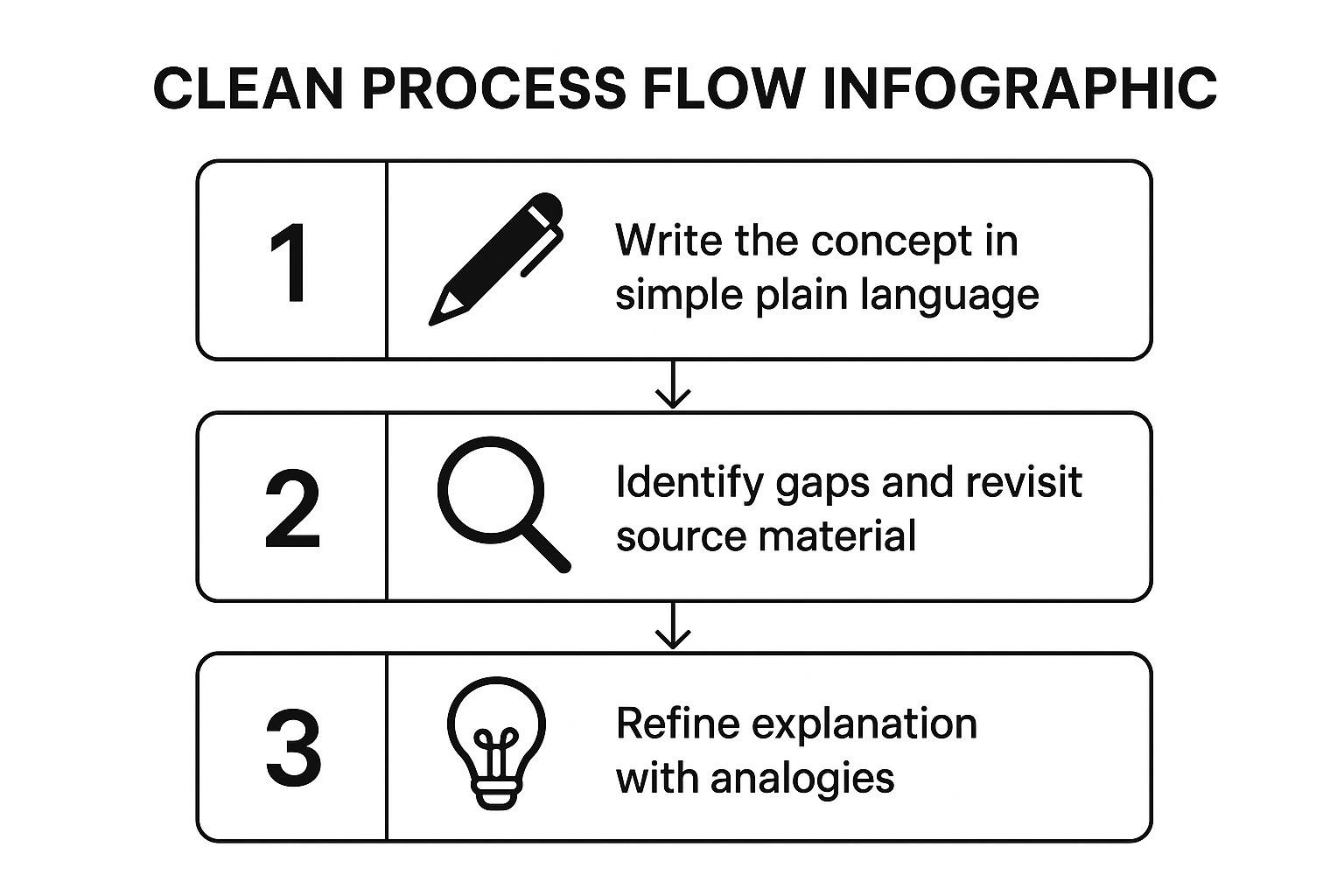
This process creates a feedback loop that methodically turns weak understanding into solid knowledge by forcing you to simplify and refine your explanation.
How to Implement the Feynman Technique
Applying this technique requires little more than a piece of paper and a commitment to intellectual honesty. It’s about challenging yourself to be a teacher.
- Start with a Blank Page: Choose the concept you want to master (e.g., "General Relativity") and write its name at the top of a blank page. Then, write out an explanation as if you were teaching it to a 12-year-old.
- Use Simple Analogies: Avoid technical terms like "spacetime curvature." Instead, create analogies. For instance, you could explain it as, "Imagine a bowling ball on a trampoline. The ball makes a dip in the surface. If you roll a marble nearby, it won't travel in a straight line; it will curve towards the bowling ball. Gravity works in a similar way."
- Identify Your Gaps: As you explain, you'll inevitably get stuck. Maybe you can't simply explain why the marble curves. Circle these areas. These are the precise gaps in your knowledge. Go back to your source material to fill them in.
- Refine and Test: After reviewing, refine your explanation until it is smooth, simple, and clear. For the ultimate test, actually explain it to a friend or family member. Their questions will be the final, and most valuable, test of your understanding.
Pro-Tip for Notion Users: Create a dedicated "Feynman Explanations" page in Notion. For each complex topic, create a new toggle. Title the toggle with the concept name, then write your simple explanation inside. When you identify a gap, highlight the text in red. Once you’ve filled the gap by consulting your notes or a tool like PDFFlashcards, change the highlight to green. This creates a visual record of your learning progress.
5. Mind Mapping
Mind mapping is one of the most powerful visual effective study strategies, transforming how you organize and connect complex information. Instead of linear, text-heavy notes, this technique uses a radiant, tree-like diagram that starts with a central idea and branches out into related concepts. By using colors, keywords, and images, mind mapping mirrors your brain's natural process of association, making it easier to see the big picture and the intricate relationships between different pieces of information.
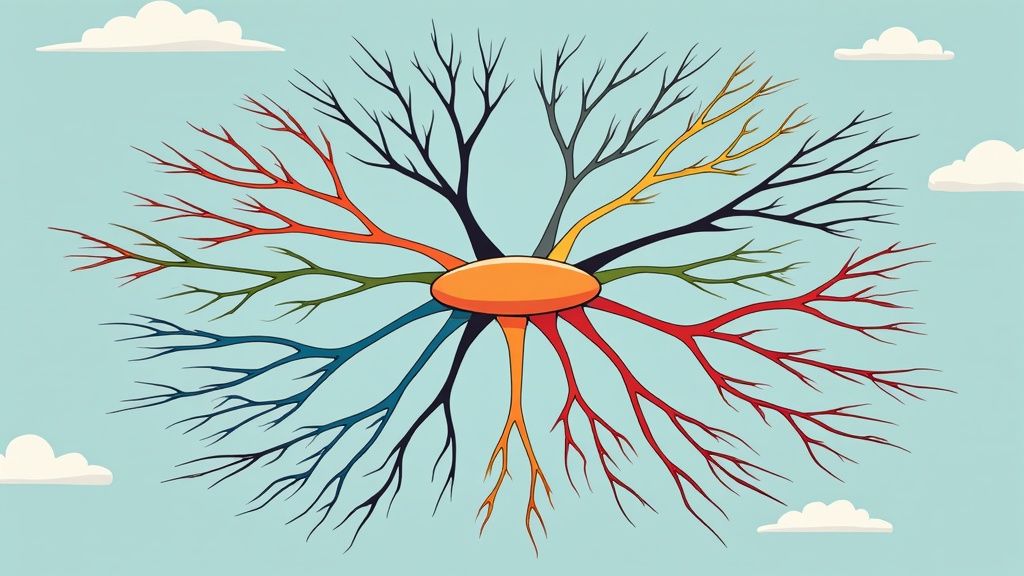
This method moves beyond simple memorization to foster a deeper understanding of the subject matter. For example, a business student could map out a marketing plan by placing the product at the center, with main branches for "Target Audience," "SWOT Analysis," "Marketing Channels," and "Budget." Each of these branches could then split into more specific details, creating a comprehensive one-page overview that is far more intuitive than a long document.
How to Implement Mind Mapping
Creating a mind map is a creative process that engages different parts of your brain. The goal is to build a visual hierarchy of knowledge that makes sense to you.
- Start from the Center: Begin with a central image or keyword that represents your main topic, for example, "The French Revolution." Drawing a small picture of a guillotine or a French flag can make it more memorable.
- Create Primary Branches: Draw thick, curved branches extending from the center for the main sub-topics. These might be "Causes," "Key Figures," "Major Events," and "Consequences." Use a different color for each primary branch to create a strong visual distinction.
- Add Secondary and Tertiary Levels: Add smaller branches off your main ones to elaborate on details. Under "Causes," you might add "Economic Hardship," "Enlightenment Ideas," and "Social Inequality." Keep labels to a single keyword or a short phrase.
- Use Visual Cues: Enhance your map with symbols, icons, and small drawings. A money bag icon next to "Economic Hardship" or a book icon next to "Enlightenment Ideas" can make the concepts more engaging and easier to recall.
Pro-Tip for Notion Users: While Notion doesn't have a native mind mapping feature, you can embed mind maps from tools like Miro or Whimsical directly into your pages. A more integrated approach is to use a Notion-friendly tool like PDFFlashcards, which can help you extract key concepts from your study materials. Use these extracted keywords and definitions as the building blocks for your mind map, ensuring all your core information is captured visually.
6. Cornell Note-Taking System
The Cornell Note-Taking System is a highly structured yet simple method that transforms note-taking from a passive transcription task into an active learning process. Developed by Cornell University professor Walter Pauk, this system is one of the most effective study strategies because it builds review and comprehension directly into your note-taking workflow. It divides a single page into distinct sections, each with a specific purpose, forcing you to engage with the material on a deeper level.
This method organizes your thoughts in real-time and primes your notes for later study sessions. I found it invaluable in my fast-paced university lectures. Instead of leaving with 10 pages of messy, unusable notes, I had a structured, one-page summary for each hour that was practically a pre-made study guide.
How to Implement the Cornell Note-Taking System
Setting up a Cornell-style page is simple. Before your lecture, divide your page into three sections: a main notes column on the right (about 6 inches), a narrower cues column on the left (about 2.5 inches), and a summary section at the bottom (about 2 inches).
- Take Notes (Right Column): During the lecture, use the main right-hand column to jot down key ideas, examples, and formulas. Focus on abbreviations and shorthand to keep up. For example, write "w/" for "with" or "dev" for "development."
- Formulate Cues (Left Column): As soon as possible after the lecture (perhaps over a coffee), review your notes. Use the left-hand "cues" column to write down main ideas or questions that correspond to your notes. For a note on "mitochondria produce ATP," the cue could be "powerhouse of the cell?" or "what produces ATP?".
- Summarize (Bottom Section): Within 24 hours, cover the right column and try to answer your cue questions. Then, synthesize the entire page into a one or two-sentence summary in the bottom section. This forces you to process the core concepts. When studying for an exam, you can simply read these summaries for a quick review.
Pro-Tip for Notion Users: You can easily replicate the Cornell System in Notion by creating a two-column layout. Use the main column for your notes and the smaller column for your cues. For the summary, simply add a final text block at the bottom inside a callout box for emphasis. This digital approach keeps your notes organized and searchable. To see how this fits into a broader digital workflow, explore some of the best note-taking apps for students and see how they can be adapted.
7. Elaborative Interrogation
Elaborative interrogation is one of the more profound effective study strategies because it targets deep conceptual understanding rather than surface-level memorization. The technique is deceptively simple: constantly ask "Why?" questions about the material you are studying. Instead of just accepting a fact, you are forced to explore the underlying reasons, causes, and connections, building a robust mental model of the subject.
Think of yourself as a detective investigating a case. A detective doesn't just accept evidence at face value; they question everything. When I was learning about supply and demand, I didn't just memorize the graphs. I asked, "Why does the demand curve slope downwards?" Answering that—because of diminishing marginal utility and the substitution effect—connected the graph to a real-world human behavior, making the concept stick.
How to Implement Elaborative Interrogation
Integrating this technique into your study routine involves cultivating a habit of curiosity and questioning everything you learn.
- Ask Foundational "Why" Questions: As you encounter a new fact, like "the sky is blue," pause and ask, "Why is the sky blue?" This pushes you beyond the fact to learn about Rayleigh scattering and how different wavelengths of light behave in the atmosphere.
- Connect to Prior Knowledge: Frame your "why" questions to link new information to what you already know. If you learn a new coding function, ask, "Why is this function more efficient than the method I was using before?" This builds on your existing mental framework.
- Generate and Test Explanations: When you ask "Why?", try to formulate an answer before looking it up. For example, "Why did the Industrial Revolution start in Great Britain?" You might guess: "Maybe because they had a lot of coal?" This act of guessing primes your brain for the real answer, making it more memorable when you confirm or correct your hypothesis.
Pro-Tip for Notion Users: Create a two-column table in Notion for your study notes. In the first column, list key facts or concepts (e.g., "Photosynthesis"). In the second column, titled "Elaboration," write down and answer your "why" questions ("Why is chlorophyll necessary for this process?"). This creates a powerful, dynamic study guide. After extracting key information with a tool like PDFFlashcards, you can add this "Why?" column to push your comprehension to the next level.
8. Interleaving
Interleaving is a powerful cognitive technique that challenges the conventional wisdom of studying one topic at a time. Instead of mastering a single subject before moving on (known as blocked practice), this method involves mixing different topics or problem types within a single study session. This approach is one of the most counterintuitive yet effective study strategies because it initially feels harder, but it builds a deeper, more flexible understanding of the material.
Think of it as a mental workout that switches between different exercises. A blocked practice session is like doing all your bicep curls first, then all your squats. Interleaving is like alternating between a set of curls, a set of squats, and a set of push-ups. It forces your brain to constantly load and reload different mental models, strengthening your ability to choose the right strategy—a skill essential for exams where problems are mixed up.
How to Implement Interleaving
The core principle is to mix, not block. This forces your brain to work harder to distinguish between concepts, which cements them more firmly in your memory.
- Mix Problem Types: If you're studying for a math exam, don't do 20 problems on calculating derivatives, then 20 on integrals. Instead, create a problem set that mixes them up. Each time you start a new problem, you have to actively decide, "Is this a derivative problem or an integral problem?" This is the real skill being tested.
- Alternate Between Subjects: Instead of studying chemistry for two hours straight, try studying chemistry for 30 minutes, then switching to 30 minutes of physics, then back to chemistry. This helps prevent mental fatigue and forces your brain to "switch gears," which strengthens recall.
- Vary Your Practice: For language learners, this means mixing activities. In one hour, you might spend 20 minutes on vocabulary flashcards (e.g., Anki), 20 minutes doing a grammar exercise, and 20 minutes trying to write a few paragraphs using the new words and grammar.
Pro-Tip for Notion Users: Structure your study plan in Notion using a weekly schedule database. Create study blocks and tag them with the specific topic (e.g., "Calculus," "Linear Algebra"). Deliberately arrange these tags so that you are alternating between different but related subjects each day. This visual planning makes it easy to ensure you're mixing up your practice effectively instead of defaulting to long, single-topic blocks.
9. Dual Coding (Visual-Verbal Learning)
Dual coding is one of the most powerful effective study strategies because it leverages how our brains are naturally wired to process information. Based on Allan Paivio's theory, this method involves combining verbal information (words) with visual information (images, diagrams, charts). By engaging both channels simultaneously, you create two distinct memory pathways to the same concept, significantly boosting comprehension and recall.
Think of your memory as a library. Storing a concept with just text is like shelving one book. Storing it with both text and a related image is like shelving two books on the same topic in different sections. When you need to find that information, you have double the chance of locating it. This is why a complex biological process like the Krebs cycle is far easier to understand with a labeled diagram than with a dense paragraph alone.
How to Implement Dual Coding
Integrating dual coding is about making your study materials multi-sensory. Instead of just reading, you should be visualizing, drawing, and connecting concepts visually.
- Draw Your Concepts: After reading a section about the water cycle, don't just write down the steps. Draw a simple diagram with clouds, rain (precipitation), a river (collection), and the sun (evaporation). Your drawing doesn't have to be a masterpiece; the act of creating it is what forges the memory.
- Pair Words with Images: When creating flashcards for a language class, don't just write the word "el perro." Find a picture of a dog and put it on the card next to the word. This creates an immediate visual-verbal link that bypasses the need for English translation.
- Annotate with Symbols: As you read a textbook, use a system of small drawings in the margins. You could use a simple lightbulb icon for key ideas, a question mark for points you need to clarify, and arrows to visually connect related concepts across the page.
Pro-Tip for Notion Users: Notion’s versatile canvas is perfect for dual coding. You can easily drag and drop images, diagrams, and videos next to your text notes. Create a two-column layout with your written summary on one side and a gallery of relevant images, charts, or embedded Miro boards on the other. For an even more streamlined process, use a tool like PDFFlashcards to generate text-based flashcards from your documents, then enrich them by manually adding relevant images to each toggle in Notion for a powerful, multi-modal study set.
10. SQ3R Method
The SQ3R Method is one of the most structured and effective study strategies for deeply understanding dense reading material. Developed by Francis P. Robinson, this five-step process transforms you from a passive reader into an active participant in your learning. It systematically guides you through Survey, Question, Read, Recite, and Review, ensuring you engage with the content on multiple levels for superior comprehension and retention.
This method forces you to build a mental framework before diving into the details. I used to open a textbook and just start reading from page one, getting lost and forgetting everything by the end of the chapter. With SQ3R, I learned to approach each chapter like a detective, looking for clues first and then reading with a specific mission. It changed reading from a chore into an investigation.
How to Implement the SQ3R Method
Applying SQ3R requires a deliberate, step-by-step approach to your reading sessions. It feels slower at first, but the gains in understanding save you significant time later.
- Survey (S): Before reading a chapter on "The Cold War," spend 5 minutes just skimming. Look at the title, headings ("The Iron Curtain," "The Space Race"), images, and the summary. The goal is to get a mental map of the chapter's landscape.
- Question (Q): Turn the headings into questions. "The Iron Curtain" becomes "What was the Iron Curtain and why was it created?" "The Space Race" becomes "How did the Space Race impact US-Soviet relations?" Write these questions down.
- Read (R1): Now, read the chapter with a purpose: to find the answers to your questions. This active searching keeps you engaged and focused, preventing your mind from wandering.
- Recite (R2): After reading each section, pause, look away from the book, and try to answer your question out loud, in your own words. For example, "Okay, the Iron Curtain was the ideological and physical boundary dividing Europe..." This step is crucial for memory consolidation.
- Review (R3): Once you've finished the entire chapter, go back to your list of questions and try to answer them all without looking at your notes. This final review solidifies the entire chapter in your mind.
Pro-Tip for Notion Users: Create a template in Notion for the SQ3R method. Use headings for each step (Survey, Question, etc.). Under "Question," list your questions as toggles. While reading, you can put the answers and key notes inside each toggle, creating an interactive study guide. This organizes your thoughts and makes the "Review" phase incredibly efficient. For more techniques to get the most out of your reading, learn more about how to improve reading comprehension.
Top 10 Study Strategies Comparison
| Technique | Implementation Complexity 🔄 | Resource Requirements ⚡ | Expected Outcomes 📊 | Ideal Use Cases 💡 | Key Advantages ⭐ |
|---|---|---|---|---|---|
| Active Recall | Moderate: requires discipline and self-testing | Low: mainly time and focus | Strong long-term retention and memory consolidation | Subjects needing memorization (e.g., anatomy, languages) | Efficient retention, identifies gaps, builds recall confidence |
| Spaced Repetition | Moderate-High: needs scheduling and consistent use | Medium: digital tools recommended | Maximizes retention by reducing forgetting | Long-term memorization and exam prep | Highly efficient, reduces total study time, adaptable |
| Pomodoro Technique | Low: simple timer-based structure | Very Low: timer and task list | Improved focus, reduced mental fatigue | Managing study/work sessions, overcoming procrastination | Easy implementation, enhances concentration, motivates |
| Feynman Technique | High: time-intensive and iterative | Low: paper/pen or digital tools | Deep understanding, identification of knowledge gaps | Complex concepts requiring deep comprehension | Enhances mastery and communication, reveals gaps |
| Mind Mapping | Moderate: creative input and organization | Low-Medium: pens/paper or digital tools | Enhanced visual memory and conceptual connections | Visual learners, brainstorming, complex topic organization | Stimulates creativity, shows relationships, memorable |
| Cornell Note-Taking | Moderate: structured layout requires habit | Low: paper/notebook or digital app | Organized notes, better engagement and review | Lecture-based courses, meetings | Promotes active listening, quick retrieval, structured |
| Elaborative Interrogation | High: mentally demanding, deep questioning | Low: mainly cognitive effort | Deep understanding, critical thinking improvement | Subjects needing conceptual depth and reasoning | Promotes meaningful learning, builds conceptual links |
| Interleaving | High: requires careful planning and mixing | Low: time and varied materials | Improved discrimination, flexible problem-solving | Skills requiring varied practice (math, languages, music) | Strengthens retention, enhances transfer, mirrors real use |
| Dual Coding | Moderate: creating visual/verbal combos | Medium: requires time to create visuals | Better comprehension and multiple memory pathways | Subjects benefiting from visuals plus text (anatomy, business) | Improves memory retention, increases engagement |
| SQ3R Method | Moderate-High: multi-step study process | Low: textbook or reading material | Enhanced comprehension and retention | Reading-heavy subjects and text comprehension | Structured approach, active engagement, long-term retention |
Integrate and Conquer: Building Your Personal Study System
The journey through the ten most effective study strategies has equipped you with a powerful arsenal of cognitive tools. We've dismantled complex topics, from the disciplined sprints of the Pomodoro Technique to the deep, explanatory power of the Feynman Technique. We've explored how Active Recall and Spaced Repetition form the bedrock of long-term memory, while methods like Mind Mapping and Dual Coding engage your brain's creative and visual centers.
But simply knowing these strategies exist is like owning a toolbox filled with state-of-the-art equipment you never touch. The true transformation in your academic and professional life begins now, in the thoughtful integration of these methods into a cohesive, personalized system. The goal is to move beyond haphazardly trying a technique here and there and start building a deliberate, strategic framework for learning.
From Individual Tactics to a Unified System
The most successful students don't rely on a single "magic bullet" strategy. Instead, they are master integrators, skillfully weaving different techniques together to suit the specific learning challenge at hand. This is where the real leverage lies.
Consider this practical scenario for a college student studying a dense biology chapter:
- Initial Engagement (SQ3R): Begin by using the SQ3R method to get a high-level overview. You'd Survey the chapter, formulate Questions from headings, and then Read actively to find the answers.
- Active Note-Taking (Cornell & Dual Coding): While reading, you use the Cornell Note-Taking System in your Notion workspace. In the main notes section, you don't just transcribe text; you apply Dual Coding, sketching simple diagrams of cellular processes alongside your written explanations.
- Consolidation (PDFFlashcards & Active Recall): Immediately after your study session, you open the chapter PDF and use a tool like PDFFlashcards to quickly generate digital flashcards directly from your highlighted key terms and definitions. This is your first act of Active Recall.
- Long-Term Retention (Spaced Repetition): You then embed these newly created flashcard decks into a Notion toggle, assigning review dates based on a Spaced Repetition schedule (e.g., Review in 1 day, 3 days, 7 days).
This isn't just studying; it's a multi-layered, systematic process. Each strategy supports the others, creating a chain of reinforcement that makes learning more efficient and far less stressful.
Your Action Plan: Start Small, Iterate Often
Building your personal study system can feel daunting, so the key is to start small and be methodical. Don't try to implement all ten strategies tomorrow. Instead, follow these actionable steps:
- Select Your "Keystone" Habits: Choose two core strategies to build your system around. For most learners, the high-impact pair of Active Recall and Spaced Repetition is the ideal starting point. They form the foundation for durable knowledge.
- Pick a "Situational" Strategy: Next, select one or two techniques to apply to specific tasks. Will you use the Pomodoro Technique to fight procrastination during your writing blocks? Or will you use the Feynman Technique on the one complex formula that just won't stick?
- Track and Reflect: Create a simple tracking page in Notion. For the next two weeks, log which strategies you used and for how long. At the end of each week, ask yourself: What felt effective? What felt cumbersome? Where did I feel most engaged?
- Refine and Adapt: Based on your reflections, adjust your system. Maybe the 25-minute Pomodoro interval is too short, so you try a 45/15 split. Perhaps you discover that Mind Mapping is your go-to for planning essays but less useful for quantitative subjects. This iterative process of experimentation and refinement is how you build a system that is truly yours.
Mastering these effective study strategies is about more than earning better grades. It's about developing cognitive autonomy, the ability to teach yourself anything efficiently and deeply. This skill is the ultimate asset in a rapidly changing world, empowering you to adapt, grow, and conquer any intellectual challenge that comes your way. You are not just studying for a test; you are building a better mind.
Ready to supercharge your Active Recall and Spaced Repetition cycles? PDFFlashcards allows you to instantly create digital flashcards from any PDF note or textbook and seamlessly embed them into your Notion workspace. Stop wasting time on manual card creation and start building your knowledge system today at PDFFlashcards.