

Let’s be honest. Have you ever crammed for an exam, felt confident, and then drawn a complete blank the next day? It’s a frustratingly common experience. I remember spending a full night before a history final just re-reading my textbook. The next morning, I couldn't even recall the major timelines. It doesn't mean you have a "bad memory." It just means you’ve run headlong into a well-known phenomenon: the forgetting curve.
This isn't a personal failure; it's just how our brains are wired to work. We're designed to shed information that isn't actively used. The speed at which this happens is actually pretty shocking. Research on the forgetting curve shows we can lose around 50% of new information within a single hour. After 24 hours, that number can jump to 70%. And after a week with no review? You could be looking at a staggering 90% loss.
The takeaway here isn't that learning is hopeless. It's that your method might be broken. Re-reading and highlighting are passive activities. To truly make information stick, you need an active system.
Why We Forget and How to Fight Back
The key is to shift from just consuming information to actively engaging with it. You need to interrupt that natural forgetting process before it takes hold. This is done by forcing your brain to work a little harder, using strategies that build stronger, more reliable neural pathways.
Instead of just re-reading, we need to build a system around a few core, battle-tested principles. Think of them as the pillars holding up everything you learn. For example, instead of just reading that "mitochondria is the powerhouse of the cell," you should be asking yourself, "How does the mitochondria produce energy, and why is that crucial for muscle cells?"
The Three Pillars of Lasting Memory
To really upgrade how you study, you need to go beyond passive highlighting. Truly effective learning stands on three foundational pillars. Mastering these will completely change how you approach your study sessions.
| Principle | What It Means for You | Why It Supercharges Memory |
|---|---|---|
| Active Recall | Deliberately pulling an answer from your memory without any prompts. It's self-testing, not just re-reading. | This struggle to retrieve information signals to your brain that the memory is important and strengthens the connection. |
| Spaced Repetition | Reviewing information at strategically increasing time intervals—just as you're about to forget it. | This interrupts the forgetting curve at the most optimal moment, making your recall more efficient and long-lasting. |
| Deeper Encoding | Connecting new concepts to things you already understand. Think analogies, stories, or asking "why does this work?" | This creates a rich web of associations, making the new information meaningful and much harder to forget. |
These three pillars work together to create a powerful system that fights forgetfulness and builds knowledge that actually lasts.
The real magic happens when you stop seeing your notes as a static library of facts and start treating them as dynamic tools for learning. Your goal should be to engage, question, and test yourself with your materials. A fantastic place to start is by learning how to take notes that are built for active recall from the moment you write them down.
Turning Lecture Notes into Powerful Flashcards
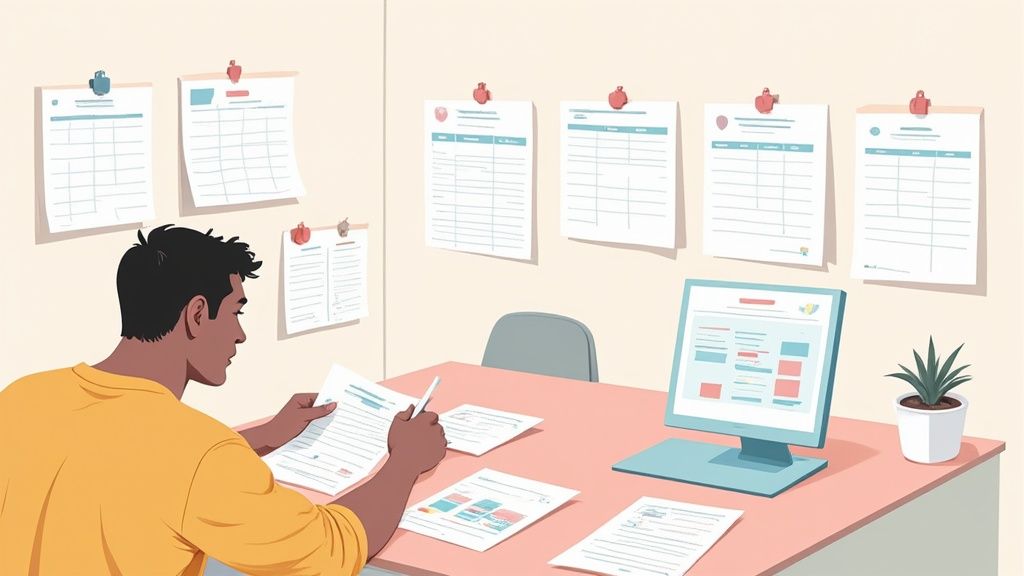
Let's get practical and talk about a technique that completely changed how I studied: Active Recall. For the longest time, my study routine was what you'd expect—highlighting textbooks, re-reading my notes, and generally hoping the information would sink in. It was a passive, frustrating process that usually ended with mediocre results and a lot of last-minute cramming.
The real shift happened when I stopped just reviewing information and started forcing my brain to actively retrieve it from memory. It’s like the difference between watching a workout video and actually doing the exercises. This simple change is the foundation of real memory retention because it strengthens the neural pathways every time you pull a fact out of your head.
From Passive Notes to Active Learning Tools
Your digital notes are a goldmine for this kind of active learning. You can take those static lecture slides and textbook PDFs and turn them into a dynamic study engine. The entire goal is to transform your material from something you just read into something that actively questions you.
This is where I started using a tool called PDFFlashcards, which works right inside Notion. It let me highlight a key term or a complicated diagram in a lecture PDF and instantly turn that selection into a a flashcard. No more tedious re-typing. This simple workflow meant I could spend my energy on what truly matters: writing good, thought-provoking questions.
The quality of your recall practice hinges on the quality of your questions. You're aiming for deep understanding, not just spitting back facts you've memorized.
For example, when I was studying biology, my early attempts at flashcards were pretty weak.
- Old Question: "What is mitosis?"
- New, Better Question: "Contrast the key outcomes of mitosis and meiosis, focusing on chromosome number and genetic variation."
See the difference? The second question makes me synthesize information, compare two concepts, and explain the why, not just the what. This is where you build genuine, long-term memory.
Crafting Effective Questions for Deeper Recall
Learning to write powerful questions is a skill, but you get better with practice. The main idea is to push yourself to think critically about what you're learning.
Here are a few actionable ways I structure my flashcards for much better results:
- Explain the "Why": Instead of asking, "What's the formula for kinetic energy?" I'll ask, "Why is velocity squared in the kinetic energy formula, and how does that affect an object's energy at high speeds?"
- Use Scenarios: For my business class, I stopped asking for the definition of "SWOT analysis." Instead, I'd create a mini case study: "Apply a SWOT analysis to a local coffee shop trying to compete with Starbucks and justify each point."
- Compare and Contrast: Forcing your brain to find the connections and differences between related ideas is a fantastic way to solidify both. For example, "What's the key difference in how a bill becomes a law in the House vs. the Senate?"
This approach turns studying from a chore into an engaging, effective workout for your brain. When you combine active recall with a seamless system for creating flashcards, you build a seriously powerful study routine.
Of course, making great flashcards is only half the battle. You also need an efficient way to review them. To dig into that, you can check out our guide on the best spaced repetition apps to make sure all your hard work pays off.
Setting Up a Smart Spaced Repetition Schedule
Creating great flashcards is half the battle. The other half? Reviewing them in a way that actually makes the information stick. That's where a technique called Spaced Repetition becomes your secret weapon. It’s a beautifully simple, science-backed method for overcoming the natural "forgetting curve" that plagues every student.
The core idea is to revisit information at progressively longer intervals—just as you’re on the verge of forgetting it. This is worlds more effective than cramming for hours the night before an exam. It’s less stressful, more efficient, and builds knowledge that lasts well beyond the test.
Your First Spaced Repetition Cycle
You don’t need fancy, complicated software to make this work. When I first started, I used a straightforward schedule that I still swear by today: the ‘1-3-7-21 Day’ cycle.
Here’s a practical breakdown of how I used it for a single chapter:
- Day 1 (Tuesday): I create flashcards for Chapter 5 and do my first review.
- Day 3 (Thursday): I review the Chapter 5 cards again. This time it's much faster.
- Day 7 (following Tuesday): A full week after the first review, I hit them again.
- Day 21 (three weeks later): The final review. By now, the information feels second nature.
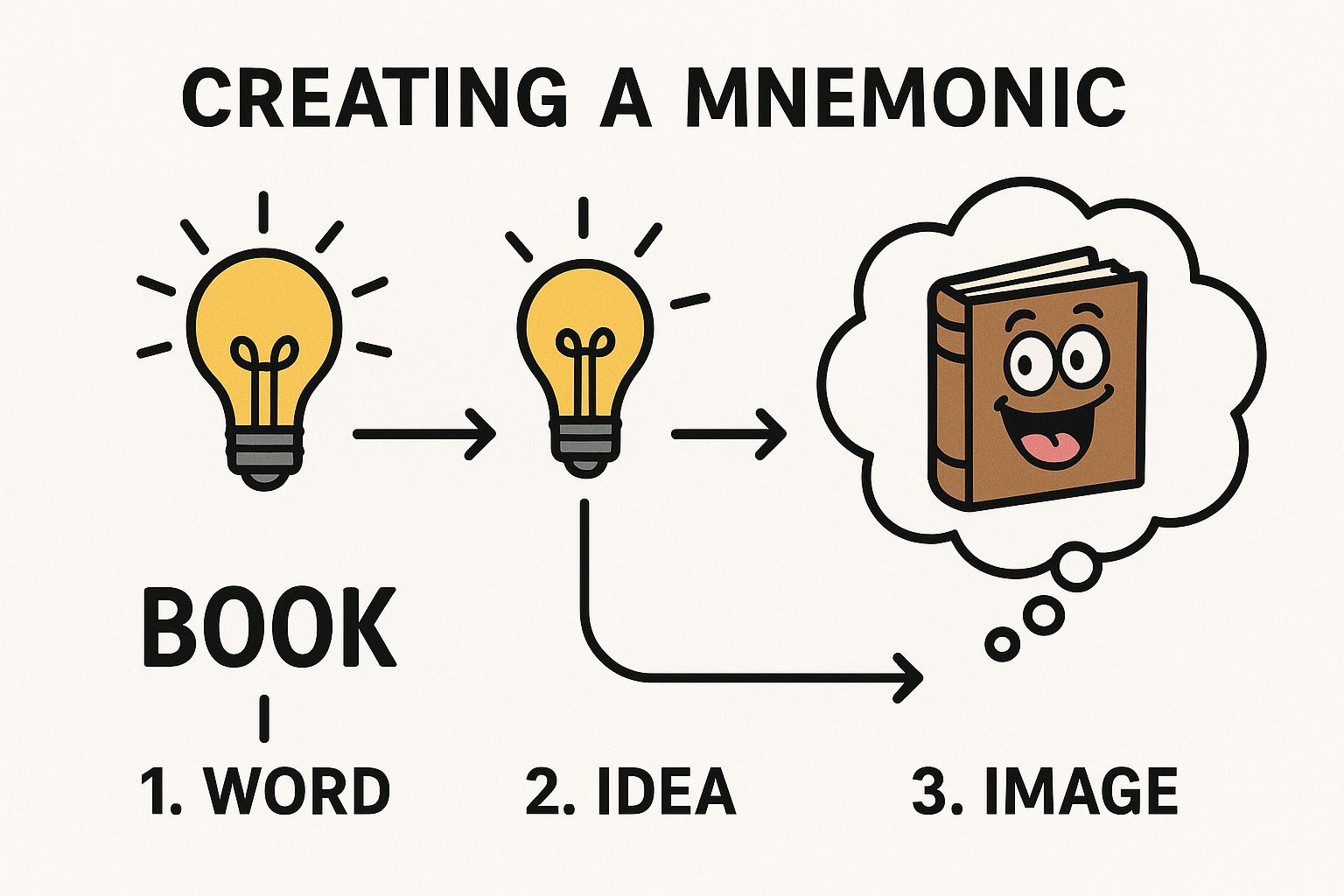
This rhythm systematically pushes the information deeper into your long-term memory each time. It’s a game-changing foundational technique, and you can dive deeper into the science behind it in our guide on how to study effectively.
The real magic of spaced repetition isn’t just about acing a test; it’s about building unshakable confidence. When you truly know the material, that pre-exam panic melts away. You've already proven to yourself, time and again, that you can recall it.
Automating the Process
Honestly, the best study system is the one you actually use. For years, I just used my phone’s calendar. If I created flashcards for Chapter 5 on a Monday, I’d immediately set reminders to review them on Tuesday, then Friday, then the following Tuesday, and so on.
You can easily replicate this right inside Notion. Simply add a "Next Review Date" property to your flashcard database. This small tweak turns a powerful memory theory into a simple, manageable daily habit you can actually stick with.
Using Stories and Analogies to Build Stronger Memories
Real learning isn't just about cramming isolated facts into your brain. It's about understanding how ideas connect to one another. To forge those strong memory pathways, you have to move beyond rote memorization and turn abstract concepts into something concrete your mind can actually latch onto.
One of the best ways to do this is with analogies. When you link something new and confusing to a concept you already understand inside and out, you’re giving your brain a familiar hook to hang the new information on.
For instance, when I was first trying to grasp the legal doctrine of 'adverse possession,' it felt incredibly abstract. So, I created a personal story: it was like if my neighbor started mowing a strip of my lawn every week. If I saw him do it for years and never said anything, he might eventually have a legal claim to it. That simple, personal story instantly made the complex legal requirements click.
Find What You Don't Know with the Feynman Technique
Another brilliant method for cementing your understanding is the Feynman Technique. It’s named after the Nobel Prize-winning physicist Richard Feynman, and it’s a beautifully simple process for pinpointing exactly where your knowledge is weak.
Here’s how to apply it right now:
- Pick a topic you're trying to learn, like "photosynthesis."
- Teach it to someone else. Grab a friend (or just a piece of paper) and explain it as if you were talking to a 10-year-old. Use simple words.
- Notice where you get stuck. You might find yourself saying, "...and then the light-dependent reactions happen...". That's a red flag. You're using jargon because you don't truly understand it.
- Hit the books again. Go back to your source material specifically to understand that fuzzy part, then refine your explanation until it's crystal clear and simple.
This forces you to move past simply recognizing the information on a page. You have to actually process it, internalize it, and make it your own—which is the secret to true retention.
This kind of focused mental effort pays dividends. Research shows that consistently engaging in these cognitively demanding activities builds up a ‘cognitive reserve,’ which directly supports your memory performance. One compelling study even found that sustained education helps delay age-related memory decline, highlighting just how powerful these deep-learning habits are. You can explore the full findings on cognitive interventions here to see the data for yourself.
It’s easy to think of studying as an active, eyes-open process, but one of your most powerful memory-boosting tools kicks in after you’ve turned out the lights. While you're asleep, your brain isn't just resting; it's hard at work, replaying what you learned during the day and solidifying those connections.
This biological housekeeping is called memory consolidation. It’s the critical process where your brain takes fragile, short-term memories and carefully converts them into stable, long-term knowledge. Pulling an all-nighter doesn't just make you tired—it completely sabotages this essential function. You're literally preventing your brain from saving its work.
Give Your Brain a Nudge Before Bed
So, how can you use this to your advantage? You can actually give your brain a "to-do" list for the night.
One of the most effective habits I've adopted is a quick, 10-minute review of my most important flashcards right before I go to sleep. It’s a simple, low-effort trick. By doing this, I’m essentially highlighting the day's key information and telling my brain, "Hey, this is the important stuff. Make sure you file it away properly tonight." Personally, I focus on the 5-10 concepts I struggled with most that day.
This isn't just a hunch; there's real science to back it up. Researchers are exploring a technique called Targeted Memory Reactivation (TMR), where learning cues are reintroduced during sleep to boost recall. My pre-sleep review is a simple, DIY version of that principle.
A fascinating study on memory and sleep cues found that TMR could improve memory retention by as much as 27%. This shows a direct link between cuing your brain during sleep and being able to recall information later.
Instead of seeing sleep as an obstacle to studying, start treating it as the final, non-negotiable step of your learning process. It’s where all your hard work gets locked in.
Of course, as you start putting these memory strategies into practice, you'll probably have some questions. It's completely normal. Let's tackle some of the most common ones I hear from students who are just getting started.
How Quickly Will I Actually Notice a Difference?
Honestly, you'll feel a change right away. The very first time you try active recall, you'll get a crystal-clear picture of what you genuinely understand versus what you just vaguely recognize. It can be a real eye-opener.
As for concrete results—like acing a quiz—you can expect to see those improvements within the first week of consistent effort. But the real magic happens over several weeks. I started this process for a notoriously difficult statistics course. After a month of consistent active recall and spaced repetition, I went from feeling overwhelmed to being one of the students answering questions in class. True, lasting strength is built over time.
Are Digital Tools a Must-Have for This?
Absolutely not. The core concepts here, like active recall and spaced repetition, have been around for a very long time, way before any apps existed. You can be just as effective with old-school paper flashcards and a simple system like the Leitner box to schedule your reviews. The Feynman Technique? All you need is a notebook and a pen.
Digital tools like Notion are fantastic for making the process smoother, especially when you're wrestling with massive PDF lecture notes. But the methods themselves don't depend on any specific tool. The best system is always the one you'll actually stick with.
Is It Better to Focus on One Subject or Mix Them Up?
This is a great question, and the research points to a clear winner: interleaving. This technique involves switching between different subjects during a single study session.
For example, instead of grinding through three straight hours of biology, a more effective plan is:
- 60 minutes: Biology (e.g., cell division)
- 60 minutes: Chemistry (e.g., balancing equations)
- 60 minutes: Back to Biology (e.g., genetics)
It feels harder at first because you're forcing your brain to constantly retrieve different types of information. But that extra effort is precisely what strengthens those neural connections and locks the material into your long-term memory.
Ready to transform your lecture notes into a powerful memory-building tool? With PDFFlashcards, you can instantly generate flashcards from any PDF and send them straight into Notion. This makes putting active recall and spaced repetition into action incredibly simple. Start studying smarter, not just harder, by visiting https://pdfflashcards.com today.