

If you really want to study more effectively, it's time to ditch the passive review and start using active learning strategies like self-quizzing and spaced-out practice sessions. This is all about moving away from last-minute cramming and embracing methods that force your brain to actually retrieve information. That's what builds strong, lasting memories.
Why Your Old Study Habits Are Holding You Back
Ever pulled an all-nighter for an exam, only to feel like you've forgotten most of it by morning? If so, you've experienced a frustrating truth: the sheer number of hours you clock in doesn't always lead to better grades. So many of us were taught to just reread textbooks and highlight key passages, but honestly, those methods are surprisingly ineffective because they're completely passive.
Rereading tricks you. It creates a false sense of familiarity, making you believe you've mastered the content because your brain recognizes the words on the page. But here's the catch: recognition isn't the same as recall—the ability to pull information out of your head without any cues. Highlighting can be even worse, often leaving you with a colorful but totally disconnected set of facts without any real grasp of the bigger picture.
Moving Beyond Ineffective Methods
I remember the exact moment my whole approach changed. I was in a tough biology course, and I'd spent hours going over my super-detailed notes on cellular respiration. The problem? I still couldn't explain the process from memory.
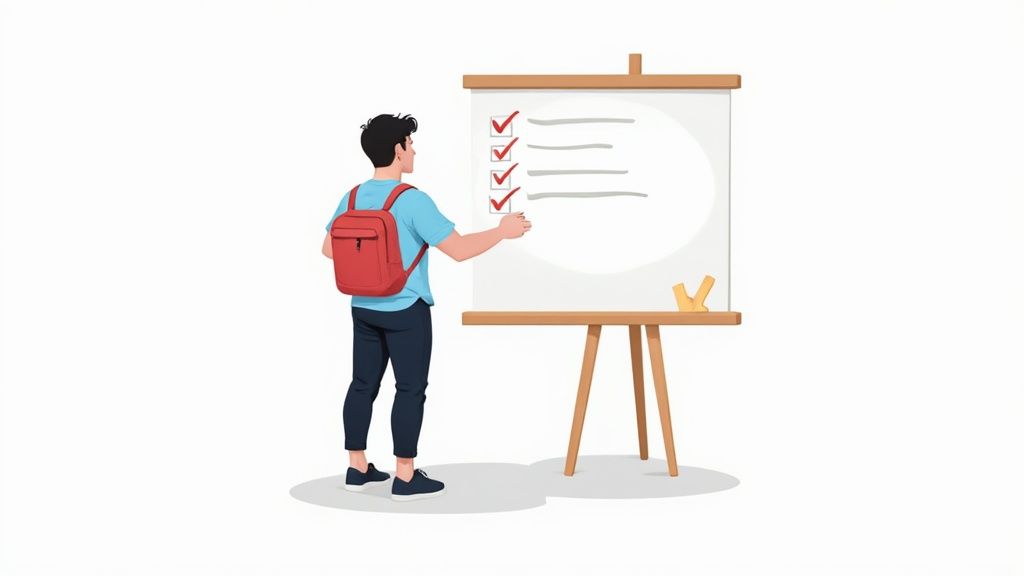
Frustrated, I decided to try something completely different. I put all my notes away, grabbed a whiteboard marker, and forced myself to draw the entire cycle from scratch, explaining each step out loud as I went.
It was hard. Really hard. It showed me just how massive the gaps in my knowledge were. But that struggle was exactly what I needed. This shift from passively reviewing to actively retrieving information changed everything for me. My grades shot up, but more importantly, my confidence grew because I finally understood the material, I hadn't just memorized it for a test.
The core principle is simple but powerful: Effective learning requires effortful engagement. The goal is to make your brain work to recall information, not just passively absorb it.
This guide is built to help you make that same switch. We're going to focus on proven, actionable strategies that help you learn better, not just longer. You'll learn how to replace those old, tired habits with powerful techniques that actually work, like:
- Active Recall: The practice of intentionally pulling information out of your memory. A practical example is closing your book and trying to summarize the chapter in your own words.
- Spaced Repetition: Reviewing material at increasing intervals over time to lock it in. For instance, studying a concept on Day 1, then again on Day 3, and then again on Day 7.
By embracing these evidence-backed principles, you can stop wasting time on study methods that don't deliver and start building knowledge that truly sticks.
Regain Control of Your Study Schedule
Ever feel like you're drowning in a sea of deadlines and a to-do list that just keeps growing? We've all been there. Smart studying isn't just about what you learn; it’s about how you manage your time to stay sane and avoid burnout. The key is to move beyond a simple checklist and build a real routine that works with your natural energy cycles, not against them.

This is all about creating a structure that guards your focus and ensures you’re making real progress every single day. Instead of constantly reacting to whatever fire is burning brightest, you’ll start proactively carving out time for what actually matters—and that includes essential rest.
Conquer Procrastination with Focused Sprints
One of the most powerful weapons in your arsenal is the Pomodoro Technique. It's a surprisingly simple but incredibly effective way to break down those huge, intimidating tasks into manageable, bite-sized intervals. Instead of staring at your textbook thinking, "I have to study biology for three hours," you just commit to a single 25-minute sprint of pure, uninterrupted focus.
I lived by this in college, especially for dense reading assignments. I'd set a timer for 25 minutes, toss my phone into another room, and dive into a chapter with one goal: understand this section. When the timer buzzed, I’d take a mandatory five-minute break. After four of these "pomodoros," I'd reward myself with a longer, 20-minute break. This little trick not only kept me on task but made the act of starting feel so much easier.
Design Your Week with Time Blocking
While Pomodoro is perfect for managing the moment-to-moment work, Time Blocking is how you manage your entire week. This is where you graduate from a to-do list and start assigning every task a specific home on your calendar. You're essentially creating a visual game plan for your days.
When you schedule your study sessions like appointments you can't miss, you kill the constant, draining "what should I do next?" debate. This saves your precious mental energy for actual learning.
Here’s how you can put Time Blocking into practice right now:
- Block Your Non-Negotiables First: Start with the big rocks. Plug in your classes, work shifts, and even your commute time. These are the fixed pillars of your week.
- Schedule Deep Study Sessions: Pinpoint when you're at your best. If you're a morning person, block out a 90-minute session for "Deep Work: Chemistry Problems" from 9:00 AM to 10:30 AM. Get specific.
- Add Administrative Tasks: Don’t let the little things pile up and create stress. Block 30 minutes for "Reply to Emails" or "Organize Lecture Notes."
- CRITICAL—Schedule Your Downtime: This is not optional. You have to block out time for the gym, hobbies, or just hanging out with friends. Protecting this time is what prevents burnout and makes your study sessions way more effective when you come back to them.
A typical Tuesday might look like this: a 90-minute block to review history notes, a 30-minute break, your scheduled class, and later, an evening block dedicated to drafting an essay outline. This method gives you a clear, actionable plan and turns a chaotic schedule into a predictable, productive system built for success.
The Science of Making Knowledge Stick
If you really want to learn how to study smarter, you need to understand what's happening in your brain. True learning isn't a passive activity—it’s not about just letting information wash over you. It's about actively building strong, lasting connections in your mind. This is where two of the most powerful learning concepts come into play: active recall and spaced repetition.
Think of it like building muscle at the gym. You wouldn't get stronger by just watching someone else lift weights; you have to do the work yourself. That struggle is what builds strength. Active recall is the mental equivalent of lifting those weights. It’s the simple, but difficult, act of pulling information out of your memory.
Put Active Recall into Practice
So, instead of just rereading a chapter, try this: close the book and summarize the main points out loud. Or after a lecture, cover your notes and try to scribble down the key concepts on a fresh sheet of paper. That moment of struggle isn't a sign you're failing—it’s the sign that you're actually learning.
The effort you spend trying to remember something is precisely what makes the memory stronger. You're forcing your brain to work, signaling that this information is important enough to keep.
Here are a few ways I’ve seen students successfully work active recall into their study habits:
- Flip statements into questions. Go through your notes and turn every fact into a question. "The mitochondria is the powerhouse of the cell" becomes "What is the primary function of the mitochondria?"
- Teach someone else. Grab a friend (or even a rubber duck on your desk) and explain the concept to them. This forces you to organize your thoughts and quickly reveals what you don't truly understand.
- Do a "brain dump." Before you even start reviewing a topic, take out a blank piece of paper and write down everything you can remember about it. This gives you a clear baseline of what you know and what you need to focus on.
Lock in Knowledge with Spaced Repetition
Now, let's pair active recall with its perfect partner: spaced repetition. This is all about reviewing information at increasing intervals over time. It's the exact opposite of cramming for an exam, which only creates flimsy, short-term memories that vanish almost as quickly as they're made.
This chart shows just how dramatic the difference is. Look at the retention rate after just one week when you space out your learning versus cramming it all in at once.
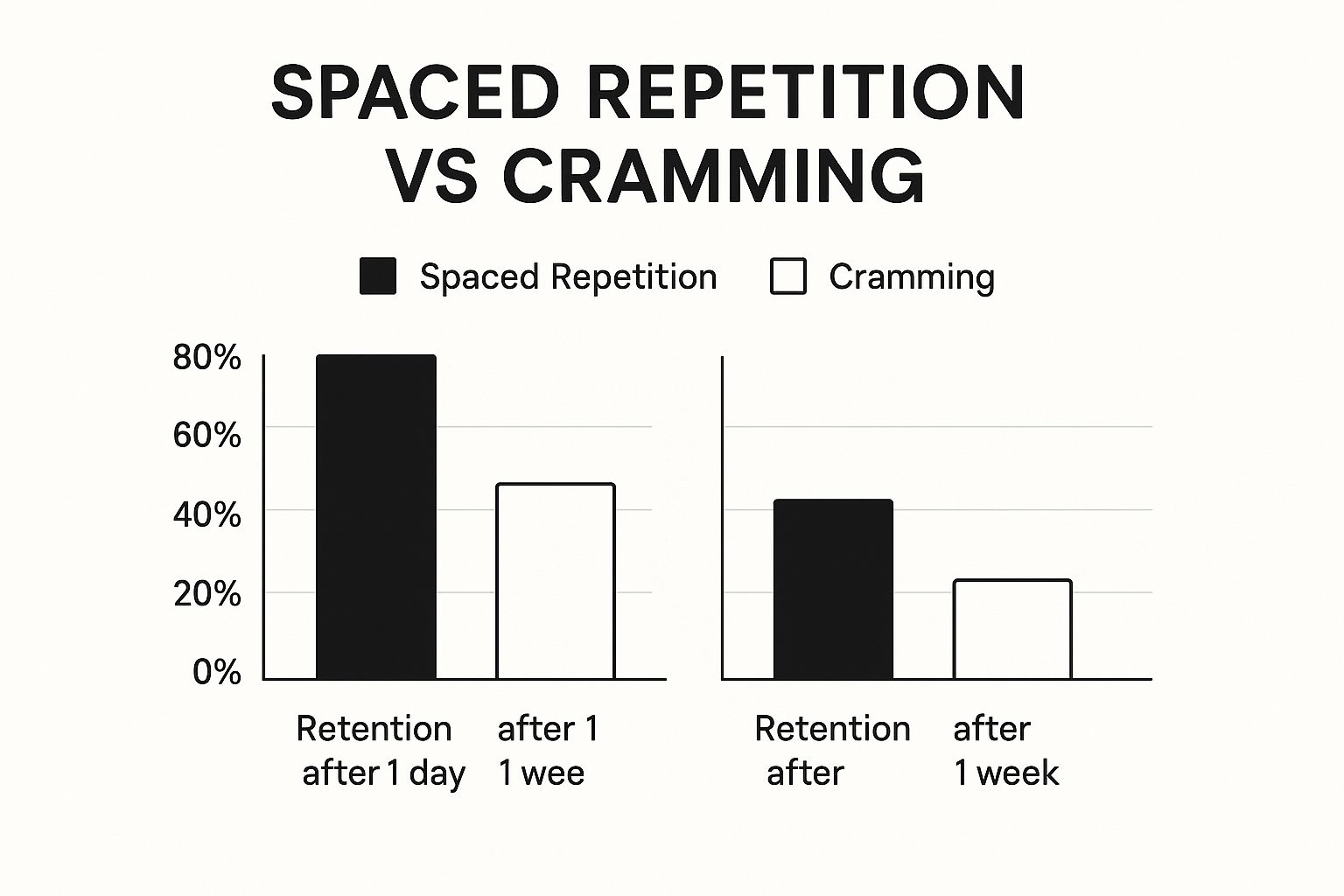
The difference is stark. Spaced repetition fights against the "forgetting curve," leading to much higher long-term retention. If you want to explore these methods further, our full guide on how to study efficiently is a great next step.
This "spacing effect" works by interrupting the brain’s natural tendency to forget. Each time you revisit a concept right as you're about to forget it, you reinforce that neural pathway, making it stronger and harder to break. A practical example would be reviewing a set of history flashcards on Monday, then again on Wednesday, and then again the following Monday.
Traditional vs Evidence-Based Study Techniques
We’ve all been guilty of using study methods that feel productive but don’t actually lead to long-term learning. Let's compare some of those common habits with the evidence-based techniques we've just discussed.
| Study Technique | What It Is | Effectiveness & Outcome |
|---|---|---|
| Rereading & Highlighting | Passively reading text multiple times, marking key phrases. Feels familiar and easy. | Low. Creates a false sense of mastery without building recallable knowledge. Minimal long-term retention. |
| Cramming | Massed practice—studying intensely in one long session right before an exam. | Very Low. Might work for short-term recall (i.e., the next day's test), but information is forgotten almost immediately. Leads to high stress. |
| Active Recall | Deliberately retrieving information from memory (e.g., using flashcards, practice questions). | High. The effort of retrieval strengthens neural pathways, leading to durable, long-term memory. |
| Spaced Repetition | Reviewing material at increasing time intervals (e.g., Day 1, Day 3, Day 7). | High. Interrupts the forgetting curve, systematically moving information into long-term storage for much better retention. |
The takeaway here is clear: focusing on active, effortful strategies like active recall and spaced repetition will always beat passive review in the long run. The data backs this up, too. A comprehensive survey of student behaviors found that those using active recall showed exam score improvements of 15-20%, with similar gains for those who adopted spaced repetition over cramming.
Building a Powerful Digital Study Hub
Knowing the science behind smart studying is one thing. Actually putting it into practice consistently? That's a whole different ball game. This is where a central, digital system can be a game-changer. I’m not just talking about folders for your files; I mean building a living, searchable knowledge base that actually helps you learn.
The need for this has exploded recently. With the massive shift to online learning, how we get and use course materials has completely changed. Back in 2019, about 2.4 million students were studying entirely online. By 2020, that number skyrocketed by nearly 200% to 7 million. That surge really drives home the need for digital-first study methods that can keep up. You can discover more insights about the evolution of online learning and what it means for students today.
A good digital hub isn’t just for storage. It’s about turning those passive lecture slides and dense textbook PDFs into an interactive study engine—one built from the ground up for active recall and spaced repetition.
From Static PDFs to an Interactive Knowledge Base
My own study habits completely changed when I stopped treating my digital files like a dusty filing cabinet and started viewing them as my own personal wiki. The key was figuring out a workflow to quickly turn a 50-page PDF into something I could actually use to quiz myself.
This is where a tool like Notion, paired with an AI flashcard generator, really shines. The goal is to pull the key ideas out of a static document and automatically create questions, summaries, or flashcards. You can then drop all of this gold into a custom database right inside your Notion workspace.
Here’s a glimpse of what a well-organized Notion database for a single course can look like.
See how every lecture gets its own entry? It has properties for the topic, date, and review status, making it super easy to spot what you need to work on next.
A setup like this lets you move beyond just reading and rereading. You can filter notes by topic, sort them by how well you know the material, and even use Notion's toggle feature to quiz yourself right on the page.
Your Action Plan for a Smarter Workflow
Ready to build your own? The process is a lot simpler than it sounds and creates an amazing feedback loop for your brain. You can adapt these steps for just about any subject.
Pick Your Hub. First, choose a central app for everything. I'm a huge fan of Notion because its flexibility and database features are perfect for creating interconnected pages for each course and topic.
Process Your Materials. After a lecture, don't just dump the PDF into a folder. Use a tool built to analyze it. I personally use PDFFlashcards to upload my lecture slides. The AI then gets to work pulling out the most important terms and concepts.
Generate Your Prompts. This is where the magic happens. The tool automatically creates flashcards or questions from all that extracted information. This saves hours of manual work and instantly hands you a ready-made set of active recall prompts.
Organize in Notion. Finally, export your new flashcards directly into a dedicated Notion database for that course. I recommend setting up columns for the "Question," "Answer," "Topic," and a "Last Reviewed" date—this last one is crucial for making spaced repetition easy.
By automating the creation of study materials, you free up mental energy to focus on what actually matters: the effortful process of recalling and understanding the information.
This workflow turns a passive document into an active learning tool in just a few minutes. You’re no longer just consuming information. You become the architect of a personalized study system designed to help you learn better and make that knowledge stick for good.
Optimize Your Environment and Mindset
https://www.youtube.com/embed/yzd2q43A-6A
It's tempting to think that acing your exams is all about the study techniques you use. But even the slickest methods will fail if your environment and mindset are constantly working against you. We spend so much time focusing on what to study, we often forget that where and how we study are just as important.
Think about it this way: your surroundings are constantly sending signals to your brain. Your couch screams "relax," and your bed says "time to sleep." When you try to force complex information into your head in these places, you're creating a mental battle you're bound to lose. The single most powerful change you can make is to create a space that’s just for studying.
Design a Distraction-Free Zone
Your study zone doesn't have to be an elaborate setup. It just needs to work. The main goal here is to strip away anything that pulls your attention from the task at hand, making it easier to slip into a state of deep focus. A cluttered desk equals a cluttered mind, so the first step is always to clear your physical space of anything that isn't essential for your current session.
Of course, a tidy desk isn't enough to combat digital noise. A practical action you can take right now is to install a website blocker. I personally rely on browser extensions like Freedom or StayFocusd to block social media and news sites during my work blocks. It’s not about willpower; it’s about removing the temptation altogether so your brain has no choice but to engage with your material.
Interestingly, research shows that simply changing your environment can give your memory a jolt. Studying in a new place—even just moving from the library to a coffee shop—can challenge your brain and promote more active learning. This is partly why students who study abroad often show huge gains in problem-solving and resilience; the novel environment forces them to engage more deeply with everything. You can see some of the academic findings on how new settings impact learning for yourself.
Cultivate a Growth Mindset
Getting your physical space right is a huge win, but your mental environment is the other side of that coin. This is where adopting a growth mindset becomes your secret weapon. It’s the simple but powerful belief that your intelligence isn't fixed—it can be developed with effort.
When you run into a brutal problem, what’s your first thought? Is it, "I guess I'm not smart enough for this"? Or is it, "Okay, this is tough, but figuring it out will make me better"? That small shift in perspective changes everything.
With a growth mindset, challenges become opportunities. That impossible chemistry problem isn't a sign of failure; it's a chance to really forge a deeper understanding. For example, instead of giving up on a tough math problem, you could say, "This requires a different approach. I'll re-read the chapter on this formula and try again." This mental reframing stops frustration from derailing your focus and, over time, builds incredible academic resilience. This approach works wonders when paired with other powerful study methods for exams.
Finally, don't forget that your brain is part of your body. All the best study habits in the world are propped up by good sleep, nutrition, and exercise. Sleep is particularly crucial for memory consolidation, which is the process where your brain files away everything you learned during the day. Trading sleep for a late-night cram session is almost always a bad deal.
Common Questions About Studying Smarter
Whenever you try a new way of studying, a few questions are bound to pop up. It’s totally normal to feel a little unsure as you ditch old habits for better ones. I've gathered some of the most common hurdles students run into, along with some straightforward, practical advice to keep you moving forward.
The idea here isn't just to throw new techniques at you, but to help you feel confident putting them into practice. Think of this as troubleshooting the little bumps in the road as you make these strategies your own.
How Long Should a Study Session Actually Be?
This is one of those areas where quality absolutely crushes quantity. Forget about those heroic four-hour marathon sessions in the library. Your brain just isn't wired for that kind of intense focus, and you'll hit a wall of diminishing returns much faster than you think.
A far better way to work is in focused sprints. The Pomodoro Technique is a great place to start:
- Study for 25 minutes. No phone, no distractions.
- Take a short 5-minute break. Get up, stretch, grab some water.
- After four of these cycles, give yourself a longer 20-30 minute break.
For most people, a super-focused session somewhere between 45 and 90 minutes is the sweet spot. A practical example I used was a 50-minute block for reviewing lecture notes, followed by a 10-minute break to make tea and step away from my desk. This keeps your mind fresh and helps you avoid the burnout that completely tanks your productivity.
What if Active Recall Feels Too Hard at First?
If it feels difficult, that’s a good sign—it means it's working! Cognitive scientists have a term for this: "desirable difficulty." That mental struggle you feel when trying to pull a fact from your memory is precisely what strengthens that neural connection. It’s the brain equivalent of lifting a weight that’s challenging enough to build muscle.
When you can't remember an answer, fight the urge to immediately flip your flashcard or check your notes. Give your brain a real chance to retrieve it. For example, if you can't recall a historical date, try to remember the context around the event first. What happened before it? Who was involved? If you're truly stuck, then go ahead and look. But the critical next step is to make a note—mental or physical—to come back to that specific question again soon. I promise this whole process gets much easier with practice.
The struggle isn't a sign of failure; it's the signature of effective learning. Embracing this challenge is what separates shallow memorization from deep, lasting understanding.
For more targeted strategies on tackling tough material, especially as exams approach, check out our guide on how to prepare for final exams for additional tips.
How Do I Start a Digital Workflow if I’m Not Tech-Savvy?
Don't try to build the perfect, all-in-one digital system on day one. The secret is to start small and build from there. Taking on too much at once is a surefire way to get overwhelmed and give up before you even really begin.
Instead, just pick one thing. For this week, make it your only goal to open Notion and create one simple page for one class. That's it. For your next lecture, try typing your notes directly onto that page. While you're at it, play around with Notion's "toggle" feature to hide answers to key questions, creating simple, on-the-fly flashcards.
Get comfortable with that one little habit first. Once it feels automatic, then you can start exploring other features, like organizing your notes into a database or trying a new tool. It’s all about small, consistent steps, not a massive, intimidating overhaul.
Ready to turn your static study materials into an active learning machine? At PDFFlashcards, we built the tool to make that happen. Just upload your lecture slides or textbook PDFs, and our AI will automatically generate flashcards you can send right into Notion. Stop spending hours on manual setup and start focusing on what actually matters—mastering the material. Try PDFFlashcards for free today and build your ultimate digital study hub.